Hiển thị các bài đăng có nhãn Concept Car. Hiển thị tất cả bài đăng

Chủ Nhật, 6 tháng 12, 2009

2009 concept Chevrolet Camaro Dusk a very tailored look with a distinct American accent

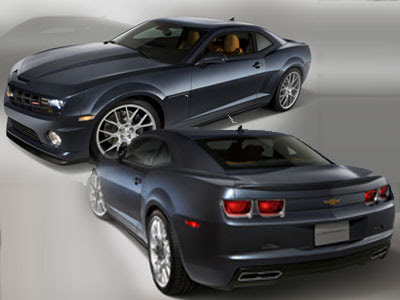
Chevrolet Camaro Dusk 2009 concept

Urban professionals,Inspired by the style of young, the Camaro Dusk concept rolls with a contemporary tuner aesthetic. It is understatedly aggressive looking, with a lowered ride height, new 21-inch wheels, the rear spoiler from an SS model and a custom ground effects package.
“This is a car with an international flair, bringing the Camaro to a place it hasn’t traditionally been,” said Parker. “It is a very tailored look that is stylish and sophisticated, but with a distinct American accent.”
Chevrolet Camaro Dusk 2009 concept

The ground effects package includes a racing-inspired front splitter, rocker extensions and a rear diffuser. They are prototype parts that may enter production as dealer-available accessories at a later date; the same goes for the 21-inch wheels from BBS. Many of the details, such as the taillamp and fog lamp bezels, match the finish of the wheels, lending a more premium look to the car.
The Camaro Dusk’s body is painted Berlin Blue, while the ground effects are painted a contrasting color. Additional performance items include the exhaust system and Brembo brakes from a Camaro SS (with painted calipers). The interior is trimmed in stylish Jet Black and Sedona, with complementing features including footwell lighting, premium door sill plates and other details.
Chevrolet Camaro Dusk 2009 concept

Today’s young professionals expect advanced technology and premium audio options and this concept delivers with a crisp, well-tuned Boston Acoustics sound system, WiFi connectivity and a convenient cradle for an iPhone.
Camaro designers dreamed up half a dozen proposals for accessory graphics packages, with the intent of soliciting feedback from Camaro enthusiasts for possible production. Chevrolet then launched the graphics campaign in mid-October, asking Camaro fans on Facebook to pick their favorite design.
The top four designs were produced and brought to the SEMA Convention, where a Silver Ice Metallic Camaro will wear each contender on a different day. At the conclusion of the convention, after thousands of enthusiasts see the graphics on the car in person and on Facebook, another round of voting will occur. The top vote-getter will be considered for future production.

Chevrolet Camaro Dusk 2009 concept

“Camaro has thousands of fans on the various social media sites and this is a great way to demonstrate that Chevrolet is connected to our customers,” said Dewar. “With so many great designs to choose from, we’re sure the voting will be close, but whatever the outcome, the real winners will be the customers who personalize their Camaro with the winning graphics package.”
The Camaro Graphics display vehicle will be located prominently in the GM display during the SEMA Convention, starting on Tuesday, Nov. 3, 2009. At the close of the convention each day, the graphics package will be changed.

Thứ Hai, 26 tháng 10, 2009

Dacia SHIFT Concept a New Innovative Concept Car powered by lithium-ion or hydrogen fuel cells.

Dacia SHIFT Concept 2012.

Dacia SHIFT Concept a New Innovative Concept Car powered by lithium-ion or hydrogen fuel cells.Dacia SHIFT Concept is a new innovative concept design that was created independently by a young Romanian designer - Liviu Tudoran. As have been said by the designer that the Dacia SHIFT Concept will be the perfect vehicle for roaming the crowded streets of 2012.
Dacia SHIFT Concept wears the design cues of the Duster concept and it will offering space for two passengers as it is an electric two-seater car. Dacia SHIFT Concept 2012.

Dacia SHIFT Concept is follows the lines of the new identity of the Dacia brand, and it will be powered by lithium-ion batteries. However, it also can accommodate hydrogen fuel cells.
Liviu Tudoran, a young Romanian designer has presented an electric sport model called Dacia Shift which runs using lithium-ion batteries and Tudoran sees the Dacia SHIFT Concept roaming the crowded streets of 2012 and offering space for two passenger. Dacia SHIFT Concept 2012.

The Dacia SHIFT Concept will be powered with the help of lithium-ion batteries and can also accommodate hydrogen fuel cells. Dacia Shift is a concept keeping the needs of the young Bucharest residents in mind, which will not exceed the stage of drawing and sketch, as it being an independent project with no official connection with the Dacia
brand.
Dacia SHIFT Concept 2012.

Thứ Tư, 14 tháng 10, 2009

2009 LM5 McLaren Concept Car by Matt Williams


2009 LM5 McLaren Concept Car

The LM5 was designed as a vehicle which could rekindle the drama and sophistication of the legendary McLaren F1. And while McLaren have since revealed the MP4-12C supercar, it's not exactly in the same league as the technological tour-de-force which was the original F1.
The McLaren LM5 is a concept created by Matt Williams, a graduate of Coventry University's Transportation Design degree program. The LM5 was produced as his final year project.
The styling of the F1 was primarily dictated by function. However it also retained a unique sense of character and presence. Williams thought it would be interesting to develop the brand identity of McLaren - but more specifically the F1 model - and bring it into the 21st Century. And while the LM5 concept was designed to offer a similar personality and overall stance to the F1, it was also designed to utilize more extreme and race-influenced bodywork.
2009 LM5 McLaren Concept Car

The McLaren LM5 concept features the same three-seat layout with a central drivers seat as the old F1. All three sports seats have an extremely slim profile to reduce weight and free up interior space, and instead of conventional safety belts all the seats feature racing-style four-point harnesses. The multifunction steering wheel features a central display for the tachometer.
The proposed engine for the McLaren LM5 concept is a worked over 5.0 litre V10 sourced from BMW. Mounted midship in the carbon fibre pre-preg chassis this unit would make the LM5 a force to be reckoned with on both road and track.
While the LM5 is at the moment just one man's idea of what the F1's successor could look like, the design itself uses both past and present McLaren influences giving it a sense of realism. And It's important to remember that McLaren themselves have made it public knowledge that they're working on developing a successor to their most iconic car within the next couple of years.

Thứ Sáu, 9 tháng 10, 2009

Honda FC Sport Hidrogen Fuel Cell Concep The fastest Sports Cars


Honda FC Sport Fuel Cell Concep

The FC Sport can be summed up like this: Imagine beating your best lap time while hearing nothing but the tires rubbing the tarmac and the quiet buzz of the high-torque electric motors. Picture a true no-holds-barred supercar with all the speed, handling and sleek looks of today's fastest sports cars, yet without the noise, heat, vibration and emissions of the internal-combustion engine.
Built as a design study, the FC Sport demonstrates Honda’s vision for making environmentally responsible vehicles that are also fun to drive. The "FC" stands for "Fuel Cell" as in hydrogen fuel cell—the same technology powering the FCX Clarity. With a 3-seat, driver-centered cockpit, a fuel cell powerplant opens the door for unprecedented engineering flexibility, allowing for a lower center gravity than any modern, piston-engined sports car. The FC Sport is symbolic of a future in which alternative fuel and zero emissions will rule the sports car world.

Gumpert Apollo Super Sports Car pure high-performance sports car with racing qualities.


Gumpert Apollo Super Sports Car.

The Apollo is the end result of a combining of skills between Roland Gumpert - ex boss of Audi Sport, Roland Mayer - owner of MTM, and Audi.The Gumpert Apollo is essentially a race car modified for the road.
Audi played somewhat of a back seat role in the Gumpert Apollo's production. Audi technology is available to the Apollo, however the car cannot directly rival existing Audi products, and Audi owns any subsequent patents from the Gumpert Apollo's development.
The Gumpert Apollo concept uses an Audi sourced 4.2 litre V8 (like the one used in the new Audi R9 sports car) enhanced by twin turbochargers making a very respectable 650 horses, all this power runs through a six speed sequential transmission to the rear wheels, and the car is capable of reaching 60 mph in 3 seconds.
The Gumpert Apollo is a two seat mid-engined race car which makes few concessions to be road legal.
Overall the car has a purposeful look, Audi design influence creeps into the centre grille, other than this the concept is quite original, if somewhat rough. The front wheel arches hug the tires in a perfect circle before dissolving into the multiple vents down the sides. Noticeable race inspired design cues include the front lip air splitter and and roof mounted triangular air intake, no doubt necessary to feed the hungry monster lurking below.

Below is the Gumpert Apollo press release.

Once the son of the god of war Zeus, responsible for the victory and the template for masculine beauty, he is now the namesake of the breathtakingly uncompromising super sports car that combines aesthetics and function like no other.
The Gumpert Apollo is the perfect synthesis of a road vehicle and track car. It evokes passion and driving pleasure beyond all expectations. With 650 bhp, 224 mph top speed and acceleration from 0 to 62 mph in just 3 seconds, you would have to go a long way to find an alternative to Apollo. The complete package is available in a cost-benefit ratio that cannot be matched in this exclusive vehicle class. As a pure high-performance sports car with racing qualities that is also approved for use on the road, the Gumpert Apollo sets new standards.
Roland Gumpert, managing director and the driving force behind the company that builds the car, has created a manufacturing environment that combines engineering excellence with wideranging automotive and racing competence. Experts within the industry are all familliar with the name Gumpert. In the mid 1970s, the long-standing Audi manager was the driving force behind the development of the vehicle "Iltis", the original predecessor of today's "Quattro". In the years undere his management, Audi won a total of 25 World Rally Championship races and was the 4-time winner of the World Rally Championship.
An Exceptional Design
The silhouette of the Gumpert Apollo, which has been optimized upon numerous times after tests in the wind tunnel, reflects its above-average performance capability. In its profile, the Apollo's dynamic appearance is further enhanced by its dimensions and its streamlined, long and wide shoulder lines. The mid-engine layout is emphasized by the cockpit, which is clearly situated toward the front of the vehicle, and the long wheel base; both factors ensuring optimum driving qualities. Massive air inlets and outlets in the front, and on the side in front of and behind the doors, leave no doubt about its potency. They supply the two turbochargers and the high-performance braking system with enough fresh air to ensure that the car maintains optimum operation for the duration of the race.

Driving Dynamics Redefined
The Gumpert Apollo's suspension was developed to ideally complement the clever aerodynamics of the car body, resulting in unusual driving dynamics. The Apollo is taut but not hard and offers the driver and passenger an extraordinary high level of comfort despite being purely designed for performance. It demands the complete attention of the pilot but does not overwhelm him thanks to its ultra-precise and predictable driving characteristics even at top speed. An ideal weight balance of 42 to 58 percent between the front and rear axis rounds it off.

Proven Performance in a New Dimension
The impressive power of the high-performance eight cylinder engine is based on the proven V8 aggregates from Audi. This engine in standard configuration is optimized for use in racing and road vehicles and produces 650 bhp as a biturbo engine. With a weight of only 430 lbs, it plays a major role in ensuring the Apollo has an ideal weight and its fascinating driving dynamics.

Via the two exhaust gas turbochargers, the combustion chambers are force-fed fresh air that has previously been cooled to the ideal temperature in large intercoolers.

The sequential six-speed transmission, that incorporates Formula 1 know-how, guarantees the efficient implementation of the energy generated.

Purism and Luxury in the Interior
Low weight was the top priority and has been achieved by using high-tech materials. For instance both the monocoque and the integrated instrument panel are made of carbon-fiber.

The seat position is individually set for every customer with padding, upholstery, adjustable pedals, and the steering column. The Gumpert Apollo is a made-to-measure sports car and in line with this principle, customers can design the interior to meet their preferences, be it pure performance or somewhat more luxurious.

The air conditioning system guarantees the perfect interior temperature while traveling. The high-end navigation system with DVD-player and sound system helps you get from A to B and delivers in-car-entertainment. The backward facing camera integral to the system helps the driver when reversing or, as Gumpert says, simply shows him how quickly the overtaken cars disappear from view.

Thứ Tư, 7 tháng 10, 2009

Toyota FT-86 Concept definitely looks cool.Toyota sports car concept


Toyota FT-86 Concept definitely looks cool.

The concept car Toyota FT-86 (that’s hachi roku in Japanese) goes back to the fundamental qualities of the classic sports car with its rear-wheel drive configuration, compact dimensions, low centre of gravity and lightweight construction. Under the bonnet there is a 2.0-litre boxer engine that is strong on both performance and environmental quality
Great to own and fun-to-drive: those are the guiding principles behind a new Toyota sports car concept that will break cover for the first time at the Tokyo motor show later this month.
The show car’s bodywork is finished in Flash Red, an eye-catching shade that contains a hint of blue. Inside, the cabin design further expresses the car’s classic sporting qualities with many of the structural elements left uncovered.

Thứ Bảy, 3 tháng 10, 2009

The Veyron Bugatti Concept Sport Car by Hartmut Warkuss


Veyron Bugatti Concept Sport Car

The Veyron was designed by Hartmut Warkuss of Volkswagen rather than Giorgetto Giugiaro of ItalDesign who had handled the three prior Bugatti concepts.
Development continued throughout 2001 and the EB 16/4 Veyron was promoted to "advanced concept" status. In late 2001 Bugatti announced that the car, officially called the Bugatti Veyron 16.4 , would go into production in 2003. The car experienced significant problems, however. High-speed stability was difficult, with one prototype destroyed in a crash and another spun out during a press demonstration at the Monterey Historics event in Mazda Raceway at Laguna Seca . Production of the Veyron was delayed indefinitely.
After the release of the car, it has become known that while each Veyron is being sold for £840,000, the production costs of the car are approximately £5 million per vehicle. As Bugatti, and therefore Volkswagen, are making such a huge loss, it has been likened by influential journalist Jeremy Clarkson to Concorde ; both are largely impractical experiments in technology and ground-breaking performance created just to prove that it could be done. A car the like of the Bugatti Veyron may not be seen in production again for some time to come, if at all.
The Veyron features a W16 engine —16 cylinders in 4 banks of 4 cylinders, or the equivalent of two narrow-angle V8 engines mated in a vee configuration. Each cylinder has 4 valves , for a total of 64, but the narrow V8 configuration allows two camshafts to drive two banks of cylinders so only 4 camshafts are needed. The engine is fed by four turbochargers , and it displaces 8.0 L (7,993 cm³/488 in³) with a square 86 by 86 mm bore and stroke.
The Veyron's 16-cylinder engine is based on the innovative "W" design introduced in the 2003 Volkswagen Passat. The Veyron's version features two 90-degree V8s offset by 15 degrees. The offset allows each cylinder to be placed close to its neighbor, which reduces the total size of the massive 8.0-liter engine. A Formula 1?style dry-sump lubrication system keeps the engine moving smoothly. It's easier to spin many small turbochargers than one or two large ones, so Bugatti employs four turbos to reduce boost lag. The strategy works: The engine creates 922 lb.-ft. of torque at only 2,200 rpm.
Putting this power to the ground is a dual-clutch DSG computer-controlled manual transmission with 7 gear ratios via shifter paddles behind the steering wheel. Or it can be driven by full automatic transmission. The Veyron also features full-time all wheel drive , necessary given the output of the engine. It uses special Michelin PAX System run-flat tires, which had to be designed specifically for the Veyron, and which are capable of running at 402 km/h (253 mph).
The car's wheelbase is 2700 mm (106.3 in). Overall length is 4466 mm (175.8 in). It measures 1998 mm (78.7 in) wide and 1206 mm (47.5 in) tall. Curb weight is expected to reach 4300 lb (1950 kg) with a power to weight ratio of 513.3 hp per ton (metric) or 4.36 lb/hp (SAE).The Bugatti Veyron has a total of 10 radiators .

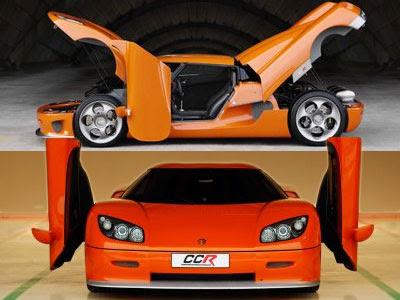
Koenigsegg CCR Design Sport Car Concept

Koenigsegg CCR Design Sport Car Concept

Koenigsegg's design seeks to give an interpretation of strength and flowing motion. The body of a Koenigsegg is formed for one ultimate purpose; speed. Its beauty is the beauty of speed itself. The surfaces are shaped to perfectly aerodynamic, an appearance that does not deceive. All aspects of this machine serve its one fundamental objective. Both the body and chassis of a Koenigsegg are made of extremely lightweight carbon fibre composite, reinforced with Kevlar and aluminium honeycomb. Its race-bred suspension system brings the driver in control of all movement, even under the toughest racing conditions.
The car was styled by Christian von Koenigsegg himself but its shape is largely dictated by aerodynamics. It is not as striking as Pagani or Enzo. At some angles it even looks bulky, like a big whale. But the whale delivers a sense of power that you can't find in its rivals either. Because of the targeted top speed, the body is designed to be so smooth that it has a very low drag coefficient of 0.30. This is much lower than Enzo (0.36), SLR (0.37) and Carrera GT (0.39). Unsurprisingly, the downside is a rather low downforce, just 50kg at the front and 70kg at the back. For comparison, an Enzo generates 775kg while Pagani achieves 500kg.
The chassis is constructed like other supercars. Central to it is a carbon-fiber tub (Koenigsegg called it "semi-monocoque") attached with steel subframe up front and aluminum subframe at the rear for mounting engine, gearbox and suspensions. Chassis rigidity is 28,100Nm per degree despite of the targa roof. The whole bodyshell is also carbon-fiber. Koenigsegg claims a dry weight of 1175kg, which translates to 1275kg when fluid and fuel are loaded, i.e., what we usually refer to "kerb weight". In other words, CC8S is about as light as Pagani and Saleen S7, while being around 100 kilograms lighter than Enzo and Carrera GT.

Bài đăng phổ biến